
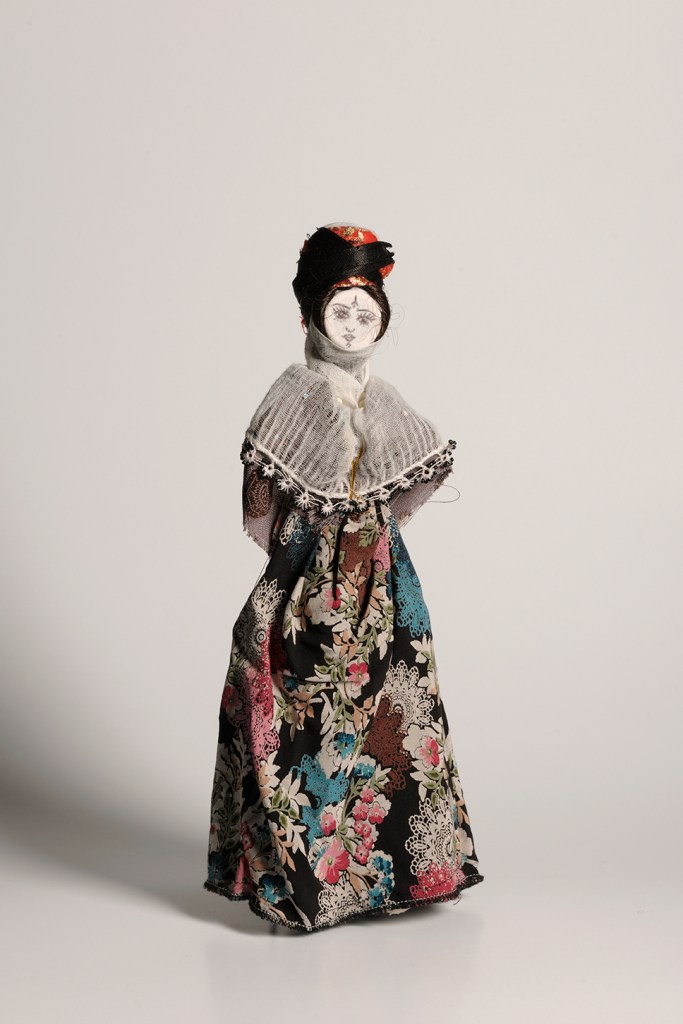
Photos Jef Rabillon
We were a large family, and the housework never ended. In the summer, we would gather almonds and walnuts from our garden, peel their shells, dry them in the sun, bag them, and store them for winter. In the fall, we would pick grapes, crush them until morning, and cook them over the fire to make molasses and fruit leather. In winter, we would crush olives with stones, fill them into flasks, and prepare them. During the cold months, we would also go to my uncles’ cotton fields to collect the leftover cotton that the workers had missed, taking it out of the tough bolls one by one and cleaning it. This cotton was second-grade cotton, somewhat muddy, mixed with dried grass and fragments of the bolls. They would pour it onto a large mat spread in the middle of the room and gather us around it, saying that in exchange for cleaning it, they would tell us stories. We never wanted to do that work, but we loved my mother’s stories. She would always make us work in exchange for telling something, which was her greatest leverage. Even now, when she tells very important and deep things, she always does so when her hands are busy.
She built our three-story house this way too. In Diyarbakır, she actually built all four floors of our house in the Bağlar district, only occasionally hiring workers to help her. I don’t remember the first two floors, but I remember the third and fourth. She would gather all the children in the neighborhood and offer them that if they carried sand upstairs, she would tell them stories, host a movie night showing a beautiful film of their choice, and serve walnuts and fruit leather during the movie. We were very embarrassed that our mother did this, but the neighborhood children would happily run to our house right after breakfast every day to start working. My mother had prepared bags according to each child’s height and age, and everyone would do as much as they could. I had a small soap bag.
Making these dolls was also her way of telling a story that was somehow difficult for her. She could only tell stories while doing something with her hands. She focused on her hands and told the story that way. She would tell us about Armenian women in our village who were forcibly Islamized, and she said she learned this from her grandmother. How did her grandmother know so much, and how did these stories come to be told from the perspective of the women? My mother is a fully practicing Muslim woman. This year, she casually told me this story as if in passing. Her own family came from a well-known family in Mardin. The Yakubi clan was originally Syriac and had converted to Islam to survive the 1915 Syriac Genocide. In fact, my mother was telling me the story of what happened to her grandmother’s parents, whose name she had given me; I only learned this this year.
My mother cannot tell a story without working with her hands, and we cannot listen to her stories without something to do with our own hands. It’s a strange habit. We would look at our hands and imagine the worlds she created with her stories. One day, in Sulaymaniyah (since I couldn’t go to Turkey, they had come to visit me), my mother, my sister, and I made these dolls together.
*
While I was working as a journalist in a war zone in 2015-2016, my mother waited for a long time for the war to end and for us to finally be reunited. For a year, she only talked to me on the phone for a few minutes, once a week, and every time she said, “When the war is over and you come home, I’ll cook your favorite meal.”
After a year, the war was over.
Six districts of the city where I worked were wiped out by months of bombing, and hundreds of people lost their lives. I managed to sneak out of the ruins. Thinking I had escaped, I called my mother and told her I’d be home tonight. She began to prepare my favorite meal, but soon I was surrounded by the police. My mother had to wait five months for my return.
After these five months of preventive detention, at the first hearing the judge decided that I should be tried under judicial supervision and I was released. I finally returned home, where I managed to fall asleep in the arms of my mother and father.
This respite was short-lived. I then exhibited the paintings I had made in prison in Diyarbakır, and the police came looking for me again. I hid in an apartment in Istanbul and never came out. Another five months away from my parents. After five months in hiding, I was arrested again and imprisoned.
When my mother would visit me in prison, she would console herself by saying, “At least now we can see your face”. But the endless waiting became longer and longer, and she had become fragile, immersed in singular feelings, naive, almost like a child. She had returned to the inner world of childhood. Perhaps she wondered what a child would do in a similar situation. I don’t know, I’ve never asked her since. She made a doll, like she used to do when she was a little girl. She had a real dialog with this doll, which she called “Zehra”. Every day she talked to it, sang to it:
The intimate world of a mother who makes a doll out of a branch from her garden, who talks to this “Zehra” for three years, who sings laments for her… Maybe that’s how she was able to cry and lighten the weight of her heart a little.
When I regained my freedom after three years in prison and saw that doll, I had very strong feelings. It was as if I was really that doll. My mother hadn’t accepted her daughter’s imprisonment and set her free with a metaphor all her own.
A month later, in April 2019, I was invited by English PEN to receive an award, and I was to travel to London. I also had an exhibition at the Tate Modern Museum. As I was leaving, my mother gave me another doll and said, “I’m going to miss you. These two dolls were her and me.
The exhibition I did at the Tate Modern was about the conflicts in Kurdistan. Because of that, my family’s house was raided again by the police, and I haven’t been able to go home since.
Several years later, I finally had access to the case file against me. I discovered the charges. The police were after me because of my exhibitions in Europe, because I called my country “Kurdistan”, because of what I said about my friend Nagihan Akarsel, who was murdered by the Turkish state in Souleymaniyah, and because of the letter I wrote to the street artist Banksy from prison, which he shared on his social networks.
As a result of all this, the Turkish state canceled my passport and I am now a political refugee in Europe.
Now, as I have been for the last six years, I can’t go back to my country, and I’m witnessing from afar the story of a “link” that a woman tries to keep with her daughter by naming my older brother’s baby “Zehra” and taking care of her as if she were me.
After several years, we finally met again, physically, in Iraqi Kurdistan. As we talked, we continued to make the dolls together.
First we talked about our village. My mother had told me the stories of the Armenian women in our village who, after the great massacre, had been forcibly converted to Islam, sold in slave markets, or married off as domestic slaves. She told me about these women who had somehow become family members, our blood mixed with theirs, but who could never be themselves because they were forced to be another person, another identity…
* If you would like to read my mother’s stories, please write to us.
INSTALLATION
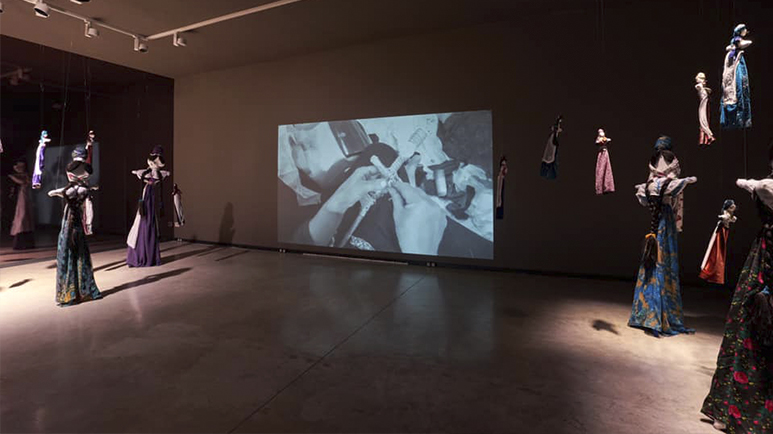
15 small dolls of about 45 cm, and 5 human-sized dolls made with wood, fabric and traditional accessories.
Video entitled “Silent”.( 58:30 mn Camera: Zehra Doğan, Video edit: Naz Oke, Venue: Soulaymaniyah / Kurdistan, Year: 2021)


 Zehra Doğan